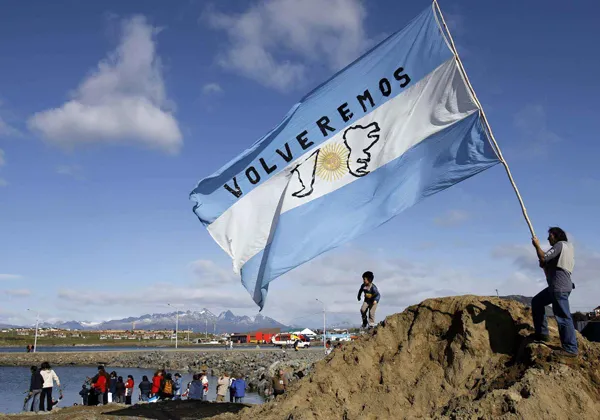
Key facts: what really happened with the U.S. shift on Malvinas sovereignty and what it means for Argentina's claim
A leaked internal Pentagon email obtained by Reuters triggered a wave of expectation in Argentina. Did Washington really change its stance on Malvinas? An analysis of what happened, what didn't, and what it means for Argentina's sovereignty claim.
1. The origin of the story: an internal Pentagon email
Between April 22 and 26, 2026, several news outlets reported information that generated enormous expectation in Argentina: the United States was reportedly considering withdrawing its historic support for British sovereignty over Malvinas. The trigger was the leak of an internal Pentagon (U.S. Department of Defense) email, first obtained by Reuters. That email, sent amid growing tensions between Donald Trump and British Prime Minister Keir Starmer, proposed potential reprisals against NATO allies that had not backed the U.S. military offensive against Iran.
Among the measures mentioned — according to Reuters and El País — was the possibility of reconsidering Washington's backing of "imperial possessions" of certain European countries, with an explicit reference to Malvinas.
2. The immediate reaction and the official denial
In response to the coverage, the U.S. State Department quickly moved to reaffirm its neutrality in the sovereignty dispute. Both AFP (reported by France 24 and El Economista) and Associated Press (AP) confirmed that a U.S. spokesperson stated that Washington's official position had not changed: the U.S. remains neutral — it does not recognize Argentine sovereignty nor does it actively support British sovereignty, though it has historically favored the UK's position in practice.
The British government, through the BBC, insisted that sovereignty over Malvinas "rests with the United Kingdom" and that it does not accept any discussion on the matter.
3. So, was there really a U.S. "shift"?
Yes and no. The key distinction:
What really happened: A mid-ranking Pentagon official drafted an internal email — not an official policy document — in which, in the context of negotiations and pressure on allies, the possibility of reviewing support for British claims over "disputed territories" such as Malvinas was raised. That draft was never turned into a presidential directive or a change in foreign policy.
What did not happen: The United States did not change its official stance. It remains neutral on paper, though with a practical lean toward London. The "shift" was an internal leak that media interpreted as a possible tactical change within a broader negotiation (Trump's pressure on NATO over the Iran conflict).
In the words of Time Magazine: "Argentina is eyeing Malvinas again. This time, the U.S. might not back Britain" — but the same article clarifies that this is a speculative possibility arising from poor relations between Trump and Starmer, not a decision that has been made.
4. Implications for Argentina's claim
a) A diplomatic opportunity, but a fragile one
The government of Javier Milei — mentioned in Reuters and Time articles — has cultivated a relationship of ideological affinity with Donald Trump. This personal alignment could make it easier for Argentina to bring Malvinas issue onto the bilateral agenda more fluidly than previous governments. The leaked email shows that, at least within U.S. internal circles, there are those who view reviewing support for London as a useful pressure tool.
However, the official neutrality holds. Argentina has not managed to move the U.S. from neutrality to explicit support for its sovereignty claim.
b) The deterrent factor for the United Kingdom
The mere fact that a senior Pentagon official put in writing the idea of "reconsidering support for British imperial possessions" is already a symbolic gesture of enormous weight. The BBC and The Scotsman described the memo as "a historic shift in U.S. foreign policy," though it was subsequently walked back. For London, it is a warning signal: its principal ally is willing to use Malvinas as a bargaining chip in other geopolitical disputes.
This undermines British confidence that the U.S. will always back them unconditionally on the islands.
c) Not a legal or territorial advance
It is crucial that Argentines do not confuse speculation with reality. No government — not even Trump's — has announced it will support Argentine sovereignty. What changed is the political climate: for the first time in decades, a senior Pentagon official openly proposed using Malvinas question as a pressure chip against the United Kingdom.
In practical terms, Argentina's claim remains unchanged: the islands are occupied by the United Kingdom, the international community is not pressing for a resolution, and Argentina lacks the military or economic power to recover them by force. But on the diplomatic front, Argentina gains a new argument: showing that British support is neither monolithic nor eternal.
5. Final conclusion
There was no official U.S. shift. There was an internal leak that generated worldwide headlines. The White House and State Department quickly clarified that they had not changed their position of neutrality.
There was, however, a shift in the negotiating climate. For the first time, a senior U.S. official — even if only in a draft — explicitly raised the possibility that the U.S. could stop backing British sovereignty over Malvinas as a reprisal for NATO disagreements. That is politically significant.
For Argentina's claim, this episode is a door left ajar: it allows the Milei government to argue that U.S. "neutrality" could tilt toward Argentina if the bilateral relationship is handled well. But it is also a mirage if one believes the U.S. will do anything concrete without international mediation or a shift in the global balance of power.
Argentines should follow this issue closely, but without getting their hopes up. The resolution of the Falklands conflict will not depend on an internal Pentagon email, but on decades of diplomacy, multilateral pressure, and above all, a change in the global correlation of forces. This episode, however, is a signal that the United Kingdom can no longer take its principal ally's automatic backing for granted. And for the Argentine cause, that is a small but real symbolic gain.