Sharks in Patagonia: a fishery incompatible with their own biology
Five species coexist in the San Matías Gulf under threatened status. Their fate depends on an unrelenting biological equation: slow growth and low reproduction in a sea where fishing never lets up.
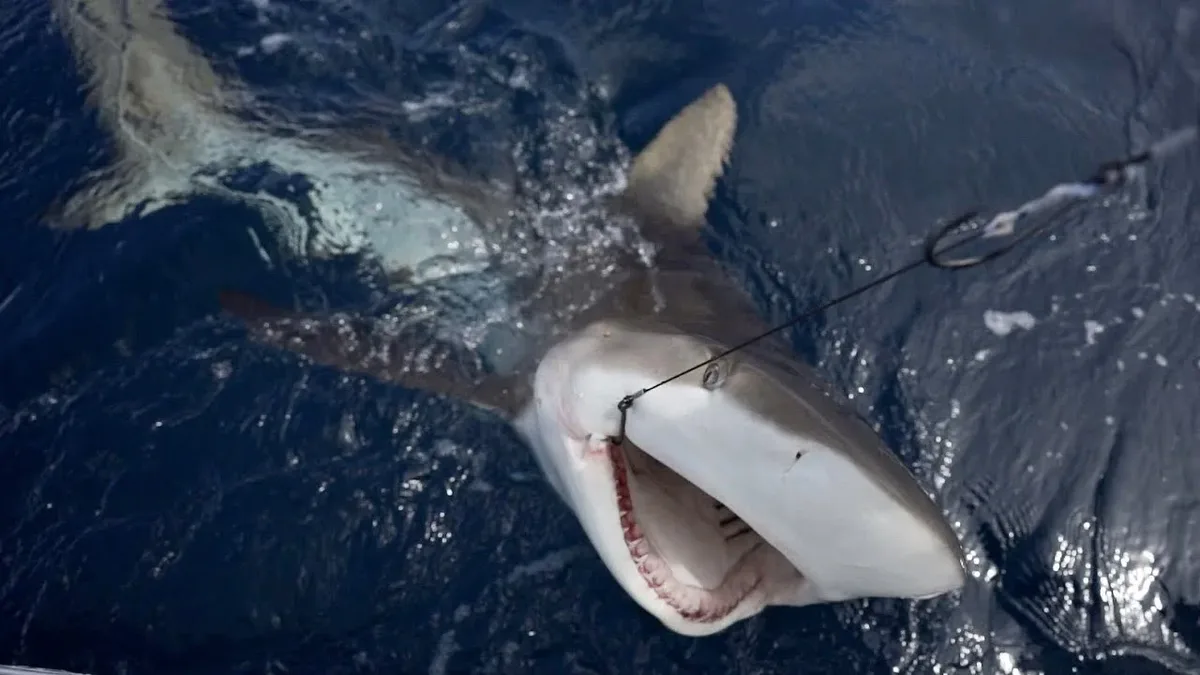
In the cold waters of the San Matías Gulf and along the entire Patagonian coast, at least five shark species inhabit these seas: the broadnose sevengill shark, the school shark, the narrownose smooth-hound, the spotted smooth-hound, and the elephantfish. All share something more than territory: they are listed in some category of threat by the International Union for Conservation of Nature (IUCN).
It is no coincidence. Nor is it a mystery. It is biology.
An equation that doesn't add up: slow growth, low reproductionUnlike most fish, sharks do not bet on quantity but on time. They grow slowly, reach sexual maturity late — sometimes after more than ten years — and produce very few offspring per reproductive cycle.
A broadnose sevengill shark, for example, can spend years developing only to produce just a handful of descendants.
That evolutionary strategy worked for millions of years in relatively stable oceans. But today it collides head-on with a pressure that did not previously exist: intensive fishing in all its forms.
Because the problem is mathematical. If an adult shark dies, there is no quick replacement. There is no population "rebound." There is a void. And that void can take decades to fill.
Species such as hake or mackerel, by contrast, release millions of eggs and can recover quickly after a population crash. Sharks do not have that margin. They never did.
When fishers notice the silenceIn the absence of comprehensive surveys, there is one indicator that cannot be ignored: those who are on the water every single day.
Sport fishers in the region have been reporting a sustained decline in shark abundance for years. Surveys by organizations such as WCS Argentina show that more than 60% perceive a clear reduction in the spotted smooth-hound; in some areas that decline reaches 80%; and the trend was already evident as far back as 2008.
The school shark (Mustelus schmitti), moreover, is not only a concern in sport fishing: its commercial catches fell by more than 50% over two decades, according to INIDEP data.
This is not an isolated impression. It is a pattern.
The illusion of catch-and-release fishingAt first glance, releasing a captured shark back into the sea seems like a responsible gesture. Indeed, regulations such as Law No. 5706 of Río Negro require it.
But there is an invisible trap hidden in that practice.
Various international studies show that between 5% and 20% of released sharks die afterward. It is not always immediate: stress, exhaustion, or internal injuries do their work in silence.
Translated into numbers: out of every 100 sharks caught, up to 20 may die regardless.
In species that take years to reproduce, that number is not trivial. It is devastating.
The dilemma: wait for perfect data or prevent collapseFaced with this scenario, biologists and conservation organizations put forward a clear position: act now.
The proposals are concrete: temporarily suspend targeted shark fishing in Patagonia, implement monitoring using non-invasive methods, and conduct in-depth studies of the real impact of catch-and-release fishing.
The precautionary principle sums it up in a simple sentence: if the harm can be serious and irreversible, waiting for absolute certainty is a luxury that cannot be afforded.
A local problem in a world that has already respondedThe concern is not exclusive to Argentina. At the global level, shark protection has been gaining ground.
In 2025, the CITES Convention included species such as the school shark and the narrownose smooth-hound in its Appendix II, imposing strict controls on their trade. Others, such as the whale shark, already enjoy even higher levels of protection.
The message is clear: sharks cannot withstand the current pace of exploitation.
An unavoidable decisionPatagonian sharks are not disappearing because of weakness, but because of an evolutionary strength that now works against them: long lifespans, slow growth, and low reproduction.
Every individual lost is a biological story that cannot be quickly replaced. It is accumulated time that dissolves.
Sport fishing, even under the catch-and-release model, is not neutral in this context. It is an additional pressure on populations that already show signs of exhaustion.
If the goal is to prevent a collapse, the conclusion imposes itself with the logic of a tide: stopping targeted shark fishing is not an extreme option — it is a measure consistent with their own biology.
Because the ocean can regenerate. But not at any speed. And definitely not at ours.