The Flag That Broke the Silence: How a Gesture on the Pitch Put the Malvinas at the Center of the World, and Milei's Awkward Reaction
The gesture by Lisandro Martínez and Lo Celso in Atlanta forced the world to talk about the Malvinas. Argentina lost the final to Spain, but the flag stayed alive: a pedagogical victory for the sovereignty cause.
 J. Martineau
🇦🇷 Argentina
J. Martineau
🇦🇷 Argentina
Malvinas — GLOBALpatagonia Report
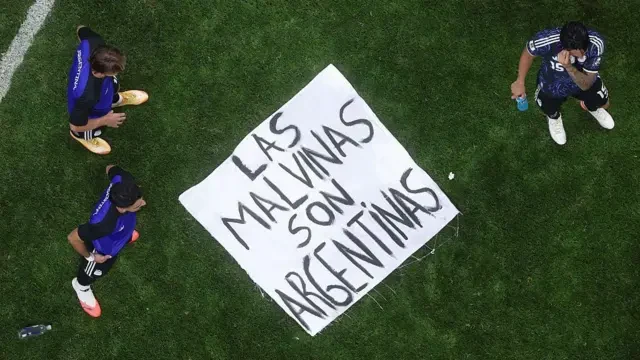
It was not just a breach of FIFA regulations. It was a historic heartbeat that crossed the Atlantic and woke a global audience that, for decades, has looked the other way. When Lisandro Martínez and Giovani Lo Celso raised that flag reading "The Malvinas are Argentine" in Atlanta, they were not provoking a rival; they were forcing the world to remember an outstanding debt.
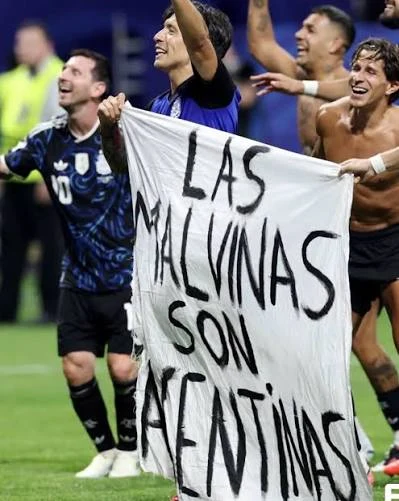
The immediate result was the chain reaction every Argentine claim needs: the international press, from the BBC to the White House, was compelled to address the issue. And that is the great paradox we must highlight from our Patagonian vantage point: for the world to talk about the Malvinas, something extraordinary often has to happen outside diplomatic channels.
The BBC article now circulating is the most compelling proof of this phenomenon. What did British journalism do? Not only report on a possible sporting punishment. It had to explain to its audience what the Malvinas are, why Argentina claims them and what happened in 1982. In other words, the gesture of two players managed, for a few hours, to lift the archipelago's sovereignty out of the historical archives and turn it into a topic of global prime-time conversation.
From Patagonia, we see clearly that this global forgetting is no accident. The Malvinas conflict is usually reduced abroad to a minor chapter of British history, or worse, to a mere geographical footnote. Yet the national team's action burst that bubble. The statements by the British Prime Minister, the unexpected defense from the White House, and even the islanders' own call for sanctions only amplified the sovereign message Argentines carry in their blood.
For our Patagonian audience, this has a special flavor. We are the gateway to the South Atlantic; we feel the wind off the islands closer than anyone. That is why seeing the whole world, from London to Washington, forced to utter the word "Malvinas" in headlines was not just a symbolic triumph inside a stadium, but a pedagogical victory for the Argentine cause.
Sport, and football in particular, has that magic: it puts on every screen, all at once, what politics and diplomacy fail to place on the agenda for years. The Malvinas flag in Atlanta was not a political blot on a match; it was a beacon that lit up a claim that, for the world, usually sits in shadow. Today, thanks to that gesture, a European citizen who had never heard of the islands, or knew them only by the English name "Falklands," perhaps took five minutes to read, to wonder why a South American country claims that territory with such passion. And that is the true power of the action: stripping the Malvinas of the label of forgotten conflict and returning them to the present.
Within Argentina itself, however, the gesture did not produce unified consensus. President Javier Milei's reaction came more than 24 hours late and, far from embracing the symbol, sought to defuse its political force. In remarks that quickly spread through the media, Milei called the players' act "cheap, tacky flag-waving," an expression that dismisses the gesture by reducing it to a superficial show of patriotism. He also branded as "despicable" anyone who tried to link the sporting triumph to political ends.
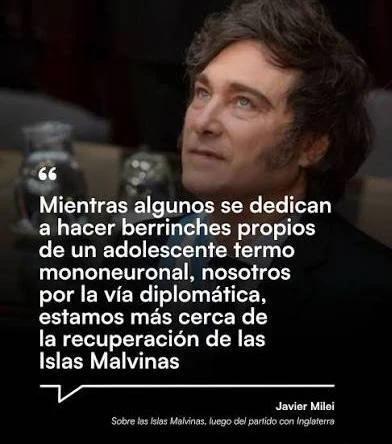
The President insisted that football and politics must stay separate and argued that the flag was an understandable expression born of the emotion of the moment, but should not be read as part of the formal diplomatic dispute. To play down the possible FIFA sanction, he minimized it as a mere fine of around 30,000 dollars, seeking to lighten the weight of the international reprisals the gesture might bring.
But perhaps the most revealing dart was aimed at his own vice president, Victoria Villarruel, who had called the English "usurping pirates." Without naming her, Milei warned that "certain mistakes are inadmissible," laying bare the deep internal differences within the ruling bloc over how to handle the Malvinas question. Despite the criticism, the president reaffirmed the sovereignty claim, stating that "the Malvinas are Argentine and we will recover them on the diplomatic plane," but made clear that for his government the path is peaceful negotiation and pragmatism, not symbolic gestures on a football pitch.
For a Patagonian outlet, Milei's reaction matters because it reveals a deep discomfort with the symbols of the Malvinas cause. While the players turned the flag into a popular cry that traveled the world, the President tried to rein it in, showing more concern about not angering England or FIFA than about celebrating the visibility of the claim. This stance, together with his government's negotiation to ban the flag in the stadium, contrasts sharply with the feeling of most Argentines and, especially, with the Patagonian view, where the sovereignty claim is not flag-waving but living memory and state policy.
On Sunday, the sporting story did not end as we dreamed: Argentina fell 1-0 to Spain in the final at MetLife Stadium, with a goal by Ferran Torres in extra time, taking the world runner-up spot in a finish full of controversy. But the result does not erase the essential. The Cup ended up in other hands; the flag, by contrast, stayed alive. What Martínez and Lo Celso ignited in Atlanta no longer depends on a scoreline: the world talked about the Malvinas again, and no trophy returns that to silence.
The tension had its epilogue on the return: stung by the defeat, the squad made clear there would be no celebration at the Casa Rosada, and the government had to shelve even the idea of a holiday. The same team that put the Malvinas on the world agenda also, on its way home, pulled away from the photo the powers-that-be were seeking.
From our Patagonian trench, we celebrate that the cry of sovereignty had such an echo. Because if anything became clear after this World Cup, it is that Argentina does not need to ask permission to speak of its islands. And that, even if FIFA wants to sanction, even if the President himself tries to tone it down, and even if the final slipped away in extra time, the history and heart of a people are not fined with money nor settled in a single match. They are defended with memory, and this time, memory reached every corner of the planet thanks to a flag and a sky-blue-and-white shirt.