The Tiny Animal That Pays the Bills in the Malvinas
It lives barely a year, is born and grows in Argentine waters, and sustains the budget of the British government that administers the islands. Galician, Taiwanese and Korean fleets pay millions for licences Buenos Aires considers illegal, over a resource that has already shown it can vanish: in 2024, for the first time in history, an entire season had to be cancelled. An X-ray of the business that decides the islands' financial fate.
 J. Martineau
🇦🇷 Argentina
J. Martineau
🇦🇷 Argentina
South Atlantic — GLOBALpatagonia Report
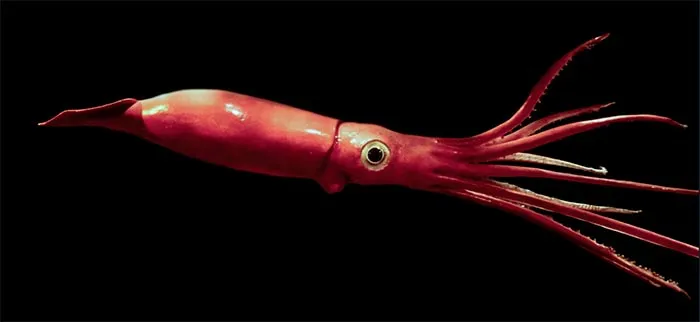
Few economies in the world depend so heavily on a single animal. The Illex argentinus — the Argentine shortfin squid — lives about twelve months: it hatches, migrates, spawns and dies in a single cycle that begins in the waters of Argentina's continental shelf and ends, to a large extent, inside the zone that the British government of the Malvinas Islands administers and licenses as its own. Every austral summer, that brief, erratic creature decides whether the islands' books balance or not.
The island administration lives off selling fishing licences. Since 1987 they have been its main source of genuine revenue: a historical average of about £20 million a year, which at times funded between 50% and 75% of all its operating and capital spending. More than half of that revenue comes from squid. Malvinas oil, so often talked about, remains a promise; squid is the real cash box — the one that pays salaries, public works, and part of the scaffolding that sustains the British occupation of the archipelago.
Two squids, two fleets
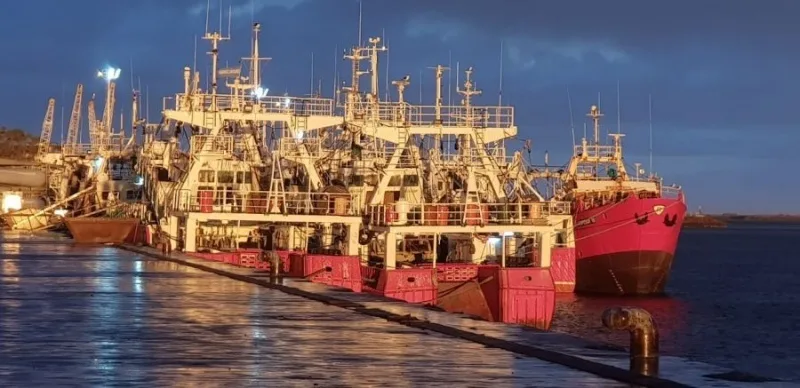
The business stands on two legs. The first is Illex, caught by jigger vessels — the light-covered ships that glow at night like floating cities. Type B licences are bought mostly by fleets from Taiwan and South Korea, the same flags that dominate the fishery across the region. This year the island government issued 105 licences for the squid season — permits that under Argentine law are plainly illegal: they are issued over waters under a sovereignty dispute, where Argentina cannot exercise control.
The second leg is less known and more lucrative per tonne: the Patagonian squid or Loligo (Doryteuthis gahi), the small squid Europe eats as calamari. There are no Asian jiggers here but freezer trawlers backed by Spanish capital. At least seven Galician companies — Lanzal, Grupo Pereira, Pescapuerta, Copemar, Ferralmes, Hermanos Touza and Moradiña — have operated for decades through joint ventures with firms registered in the islands. The scheme lets them flag their vessels as islanders and access the licences issued in Puerto Argentino (Stanley).

The numbers of that partnership explain why nobody wants to let it go. In the first Loligo campaign of 2026, the 16 trawlers of the joint-venture regime caught more than 42,000 tonnes in 64 days, a season valued by the trade press at close to US$500 million once placed on the European market. For this year's licences, the Spanish companies will pay the island government some €13.4 million. The margin speaks for itself: for every euro in licences, dozens of euros in squid.
A resource that has already shown it can vanish
The whole structure rests, however, on fragile biology. Squid live one year: there is no accumulated stock, no reserves swimming from one season to the next. Every season depends on the new generation showing up. And in 2024 it didn't: for the first time in the fishery's history, the Loligo season was cancelled entirely for lack of biomass — unprecedented since the islands began licensing fishing.
The season returned in 2026 — the February scientific survey estimated a central biomass of 41,725 tonnes and fishing opened normally — but the scare left its mark on the islands' public accounts. The 2026/27 budget, approved weeks ago, is the portrait of a strained economy: a total appropriation of £216.3 million (about US$290 million), with fishing-sector corporate tax revenue falling after the weak Loligo seasons and a projected operating surplus of less than US$300,000. The island government's reserves, once worth 3.1 times its departmental spending, would fall to just 1.2 times by 2027/28, while the islands take on a £150 million infrastructure loan.
- ~£20 million/year: historical average of island revenue from fishing licences (down to £12–15 million in recent years).
- 105 squid licences issued in 2026, considered illegal by Argentina.
- 7 Galician companies run the Loligo fishery via joint ventures; 16 trawlers, 42,000 tonnes, ~US$500 million in the first 2026 campaign.
- €13.4 million is what the Spanish firms will pay for this year's licences.
- 2024: first full cancellation of a Loligo season in history.
- 156,813 tonnes landed by Argentina's jigger fleet in 2026: a second consecutive record.
On the other side of the line
Meanwhile, on the Argentine side, the same squid is enjoying an unexpectedly sweet moment. The 2026 season of the national jigger fleet closed with 156,813 tonnes landed, the second record year in a row. Abundance inside the Exclusive Economic Zone had a revealing side effect: the famous foreign fleet at mile 201 — the outer edge of the EEZ where hundreds of vessels with no licence from anyone crowd every summer — visibly shrank, because this year the squid was inside.
That mile-201 fleet is the silent third leg of the business: about 50% of the vessels are linked to Chinese companies, many under flags of convenience from Vanuatu, Tanzania or Kenya, and nearly 30% are Spanish. They catch for free what the islands license and Argentina regulates: the same resource, three different regimes, a single school of squid.
Buenos Aires, for its part, has decided to play at catching the squid before it migrates: the Federal Fisheries Council launched a call this year to add 18 new jigger vessels to the national registry, the biggest fleet expansion in decades. The logic is simple and somewhat raw: Illex hatches and fattens in Argentine waters; every tonne caught inside the EEZ is a tonne that will never pay a licence in Puerto Argentino nor fill Chinese holds at mile 201.
The paradox of the school
The result is one of the South Atlantic's most singular economic paradoxes: a one-year-old animal that recognizes no lines in the water simultaneously finances Argentina's fleet, Galicia's fishing companies, Taiwan's shipowners and the budget of the British government that administers a territory Argentina claims. When squid is plentiful, everyone wins and nobody argues. When it fails — as in 2024 — the islands discover in their own accounts what biology repeats every season: their economy depends on a resource they do not control, that is not born in their waters, and whose fate is decided, school by school, in the Argentine sea.
Based on data from the islands' Fisheries Department, the islands' 2026/27 budget, Argentina's Federal Fisheries Council, Revista Puerto, Pescare, MercoPress and specialized trade press.