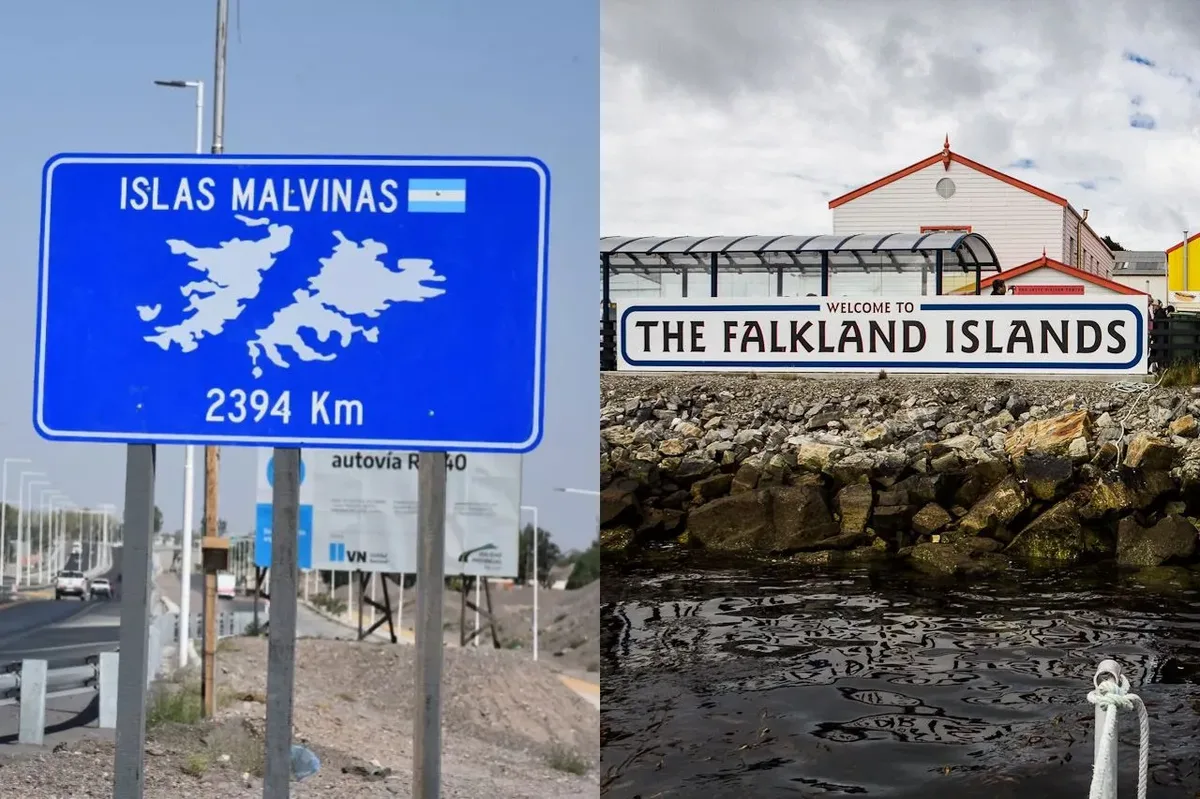
Disunited Kingdom: Britain's Constitutional Crisis and Its Real Impact on Malvinas
A report examining, through constitutional law and geopolitical analysis, why the independence push in Scotland, Wales and Northern Ireland is reshaping the board in the dispute over the islands — and what the real limits of that opportunity are for Argentina.
 M. Galindo
🇦🇷 Malvinas
M. Galindo
🇦🇷 Malvinas

To understand the scale of what is happening, one has to start from a legal foundation the media usually skip: the United Kingdom has no codified constitution. Its territorial architecture rests on a patchwork of union treaties, acts of Parliament and unwritten political conventions.
The United Kingdom is not a conventional unitary state: it is an asymmetric union
Constitutional scholar Nikos Skoutaris, of the University of East Anglia, put it precisely in an analysis published in May 2026: the United Kingdom operates under an "asymmetric constitution" in which each constituent nation has a different legal status — and those differences are not technicalities, but "the fault lines along which the territorial constitution may be tested" in the years ahead.
| Nation | Legal mechanism toward secession |
|---|---|
| Northern Ireland | Has a statutory route backed by the Good Friday Agreement (1998). A border poll can be called if the Secretary of State considers a unionist majority likely. It requires the concurrent consent of London and Dublin. The mechanism exists, is well understood, and has been tested in litigation. |
| Scotland | Has a blocked route. The 2014 referendum was authorised by an Order in Council under Section 30 of the Scotland Act. Without a new order from Westminster, the Scottish Parliament cannot call a binding referendum. |
| Wales | Has a mechanism that has never been activated. Unlike Scotland and Northern Ireland, Wales has neither a precedent for a sovereignty vote nor a specific legal framework to call one. |
Scotland's blocked route is not merely a technical matter: it depends on a political decision by Westminster, and Keir Starmer's Labour government — like its Conservative predecessors — has consistently refused to authorise a new Order under Section 30. Without that consent, the legal path for Scotland remains closed no matter what the polls show.
Christopher McCorkindale, of Strathclyde Law School, published a paper in July 2026 titled One day in May: democratic pathways to secession, in which he argues that "the UK constitution is creaking" and that this creak, though barely audible beneath the noise of political scandals and Brexit, "is there if you listen closely".
The Cardiff Pact of 14 September 2026 did not change this legal architecture. What it did was make it visible: for the first time, all three devolved governments are led simultaneously by nationalist or independence-minded parties — Sinn Féin, Plaid Cymru and the SNP — and they coordinated a common strategy to demand the right to decide.
The British contradiction: the argument Argentina has always denounced
This is where the legal analysis becomes decisive for the Malvinas question. The United Kingdom justifies its sovereignty over the islands on the islanders' right to self-determination, invoking the 2013 referendum as irrefutable proof of that will. But that same principle is systematically denied to Scotland, Wales and Northern Ireland.
Argentine jurist Marcelo Kohen, professor at Geneva's Graduate Institute of International and Development Studies, showed in an academic session at CARI that this contradiction is neither new nor accidental. He compared the Malvinas case with the Chagos dispute, where the United Kingdom explicitly denied that the principle of self-determination applied to the inhabitants of that Indian Ocean archipelago, calling it "a mere political postulate". Kohen concludes that there is "a clear and flagrant contradiction between Britain's position on Malvinas and on Chagos".
Kohen's argument goes further: the population of Malvinas does not constitute a "people" in the international legal sense. UN General Assembly Resolution 2065 does not recognise the existence of a separate island people holding the right to self-determination. "The population of Malvinas has no natural development; rather, it grows according to the needs and economic circumstances created by the same colonial power," he notes. "Instead of a 'people', one should speak of British control over the composition of the population."
Therefore, Kohen concludes, this is not a matter of self-determination but of territorial sovereignty: "The principle of self-determination is not applicable to the inhabitants of the Malvinas because there is an original defect: the United Kingdom arrived on islands where a sovereign state — the Argentine state — was already present, and expelled its inhabitants."
Foreign Minister Pablo Quirno took up this argument in September 2026, noting that "London's argument in favour of British territorial integrity directly contradicts its stance on the southern archipelago."
The Trump factor: geopolitical pressure, not sympathy for Argentina

The Trump administration's backing of the Argentine claim should not be read as a gesture of ideological affinity. It is a pressure tool against London, set within a bilateral relationship strained by Britain's lack of support in the conflict with Iran and by what Washington sees as an insufficient contribution to NATO.
International analyst Alejandro Corbacho puts it plainly: "Great Britain is weakened. It has internal problems. And the United States, on this new board that has more to do with the hemisphere, doesn't see Great Britain as a reliable ally."
Andrés Cisneros, former deputy foreign minister and one of Argentina's leading specialists on the Malvinas question, goes further: "This is the first time Argentina's external national interest coincides with the national interest of the United States in the region." Cisneros argues that the growing dispute between the United States and China over the South Atlantic and access to Antarctica creates an unprecedented opportunity, and that Argentina must move past a purely geographic approach to grasp the conflict's strategic dimension.
Cisneros, however, adds a crucial warning: "What we lack is prestige and standing in the world for that argument to be heard and respected. And we never had the backing of any great power." The convergence of interests with Washington is real, but it does not amount to automatic support for the Argentine claim.
The UK's real military limits
The previous report assumed that Britain's internal crisis was weakening its capacity to defend the islands. Analysis by international security specialists qualifies that claim.
Iñaki Martínez Soria, an analyst in Intelligence and International Security at King's College London, draws a line between the fleet that appears on paper and the one that can actually operate. As he describes it: one of the UK's two aircraft carriers spent eight months under repair; three of the six destroyers are undergoing modernisation; and there are maintenance issues affecting frigates and submarines.
"Repairs reduce the number of available ships; supply and funding difficulties limit how long they can operate far from home," says Martínez Soria. "It is far from clear that the United Kingdom could sustain an overseas operation the way it did, for example, in the past."
In 1982, with a larger and more operational fleet, British logistics were stretched to the limit. The reasonable doubt is how today's capabilities would respond to the added demands of combat.
This does not mean Argentina could retake the islands through a British collapse. It means the military equation is more fragile than London publicly admits — and that fragility is a relevant data point for any serious analysis of the dispute.
The geoeconomic dimension: Malvinas as a strategic assemblage
Researcher Sonia Winer, of CONICET and the University of Buenos Aires, published an article in September 2026 in the Revista de Relaciones Internacionales, Estrategia y Seguridad analysing Malvinas as a "socio-technical assemblage" linking strategic infrastructure, logistics corridors, offshore corporate platforms and contemporary securitisation doctrines.
Winer argues that, after Brexit, the islands became consolidated as "a node of mobility, ocean surveillance and transregional projection", and that the Sea Lion hydrocarbon project links transnational financial circuits, energy markets and corporate networks centred on London. The project is led by Israel's Navitas Petroleum and Britain's Rockhopper Exploration, with a projected investment of nearly USD 4 billion and first oil expected in 2028 — a fact that confirms Winer's reading of multinational offshore corporate platforms, not a purely British scheme.
This dimension is key to understanding why a potential breakup of the United Kingdom would have consequences for Malvinas that go beyond the symbolic: the archipelago is not just a sovereignty dispute, it is a geoeconomic asset embedded in global value chains.
Argentina's strategy: a conditional opportunity, not a mirage
The Milei government has hardened its rhetoric and activated legal instruments that were on the books but unused. Decree 868/2026 strengthened the administrative mechanisms tied to Law 26.659, which sanctions companies that explore for or extract hydrocarbons on Argentina's continental shelf without authorisation.
Researcher Carla Morasso, of the UNR's Interdisciplinary Centre on Malvinas and the South Atlantic, notes that the presidential announcement of September 2026 was disruptive precisely because it "revives laws that were already in force when he took office and that he had not put into effect until now", marking a shift from the cooperative approach toward London that had characterised the administration's first months.
But La Nación's editorial of 5 September 2026 adds a necessary dose of realism: "It is hard for diplomatic efforts to be effective and sustained without being backed by adequate economic, institutional and defence capacity." Argentina's strategy cannot rest on a British weakening as its foundation, but on building a stronger relative position over the long term.
Conclusion: what actually changes with the British crisis
The Cardiff Pact will not dissolve the United Kingdom tomorrow. Support for independence has not reached the thresholds nationalists themselves consider necessary to call a vote. The legal route to secession exists for Northern Ireland, is blocked for Scotland, and has never been activated for Wales.
What does change is the discursive and legal terrain. Britain's crisis exposes to the world a contradiction Argentine jurists have denounced for decades: the United Kingdom invokes self-determination to justify its control over Malvinas while denying it to Scotland, Wales and Northern Ireland. That inconsistency, academically documented and now visible in British domestic politics, is a real diplomatic asset.
Argentina's opportunity does not lie in a hypothetical recovery of the islands through British collapse. It lies in the erosion of the United Kingdom's moral legitimacy as arbiter of self-determination, and in the convergence — unprecedented, if instrumental — of strategic interests with Washington in the South Atlantic.
Seizing it requires more than lofty statements: it requires a sustained state policy, backed by economic, institutional and defence capacity. The window is open. But it will not cross itself.
- Nikos Skoutaris (UEA), "Fault Lines: The UK's Asymmetric Constitution and the Problem of Self-Determination After May 2026" — UK Constitutional Law Blog, 21 May 2026
- Christopher McCorkindale (Strathclyde), "One day in May" — 2026
- Marcelo Kohen (CARI) — legal analysis on self-determination and Malvinas
- Sonia Winer (CONICET-UBA), "Malvinas in the post-Brexit geopolitical reconfiguration of the South Atlantic" — 2026
- Andrés Cisneros — Perfil, Modo Fontevecchia, 2026
- Alejandro Corbacho, "A new scenario for Malvinas: 'this is a window of opportunity'" — Análisis Digital, 6 September 2026
- Carla Morasso (UNR) — 2026
- Iñaki Martínez Soria, "Has the United Kingdom stopped being a great power?" — La Nación, 14 September 2026
- La Nación, "Malvinas: a strategy that goes beyond oil" — editorial, 5 September 2026