What are we talking about when we talk about the "new" Glacier Law?
The bill that would amend Law 26.639 has already passed the Senate with 40 votes in favor. It narrows protection, transfers power to mining provinces, and leaves rock glaciers unprotected. Behind the lobby: Barrick Gold, BHP, Glencore, and copper and lithium megaprojects totaling more than 40 billion dollars.
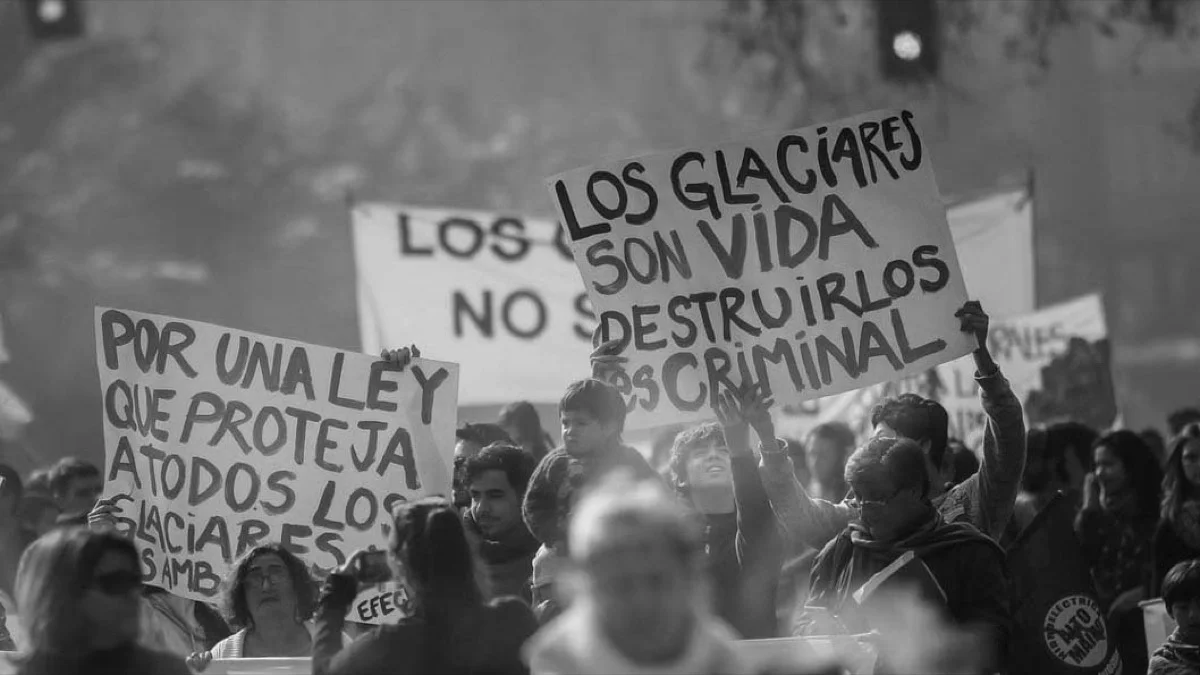
In essence, the bill amends Law 26.639, enacted in 2010, which protects glaciers and the periglacial environment — frozen soils that regulate water. The most significant changes include four pillars that fundamentally redefine the scope of the law.
1. Redefinition of protection. The current law protects all glaciers as strategic water reserves. The reform limits that protection only to ice bodies with an "effective and relevant hydrological function for the watersheds," leaving out rock glaciers — rock with low ice content — which are currently protected. 2. Transfer of power to the provinces. Mineral-rich Andean jurisdictions would be able to decide which areas are protected and which are opened up to mining, breaking the uniform nature of national minimum environmental standards. 3. Exclusion from the National Inventory. Zones could be excluded by provincial administrative decisions, without any scientific basis. 4. Subjective criteria. The concept of "relevant alteration" is introduced without defined parameters, leaving decisions that are currently prohibited by national law in the hands of local governments. The competing positions: water versus miningThe government of Javier Milei and the governors of Catamarca, Jujuy, Salta, and San Juan are pushing the reform to "streamline the regulatory framework" and unlock tens of billions of dollars in investment, particularly in copper and lithium. On the other side, organizations such as Greenpeace and the Environment and Natural Resources Foundation (FARN), along with citizen assemblies, warn that this is an "unconstitutional environmental regression" that puts freshwater reserves at risk in a context of water crisis and accelerating climate change.
Who is behind the mining lobby? Barrick Gold (Canada): its Veladero mine, in San Juan, overlaps with glaciers that feed the Jáchal River. Lundin Mining and BHP: backers of the Vicuña megaproject, one of the world's largest copper reserves with planned investments of USD 18 billion. Glencore (Switzerland): seeks to develop El Pachón — USD 9.5 billion — on the San Juan border with Chile. McEwen Cooper with Los Azules, Río Tinto, and First Quantum Minerals are also mentioned. The Senate vote — February 26, 2026The bill was approved with 40 votes in favor, 31 against, and 1 abstention. Here is how each bloc voted:
What consequences could this bring?Loss of water protection for millions of people in arid regions. The advance of large-scale mining over currently protected resources. Fragmentation of environmental policy: without a uniform national standard, each province decides over a resource that knows no political boundaries. And social and legal conflicts: the reform faces challenges on grounds of possible unconstitutionality and community resistance that is already organized.
What comes next?The bill moves to the Chamber of Deputies, where the ruling coalition will need to gather allies to secure the votes. The scenario is more uncertain than in the Senate: provincial blocs could align their position with local mining interests, but pressure from the streets and the scientific community also carries weight. FARN and Greenpeace have already announced they will challenge the law in court if it is approved, on grounds of conflict with the minimum environmental standards guaranteed by the Constitution. For Patagonia, the outcome of this debate will determine whether projects of monumental scale — Vicuña, El Pachón, Los Azules — can move forward into currently protected territories. Ice does not negotiate deadlines.
The debate over the Glacier Law is, in essence, a debate about what kind of country Argentina wants to be: one that prioritizes attracting large-scale mining investment, versus one that places water protection as a non-negotiable minimum floor.